
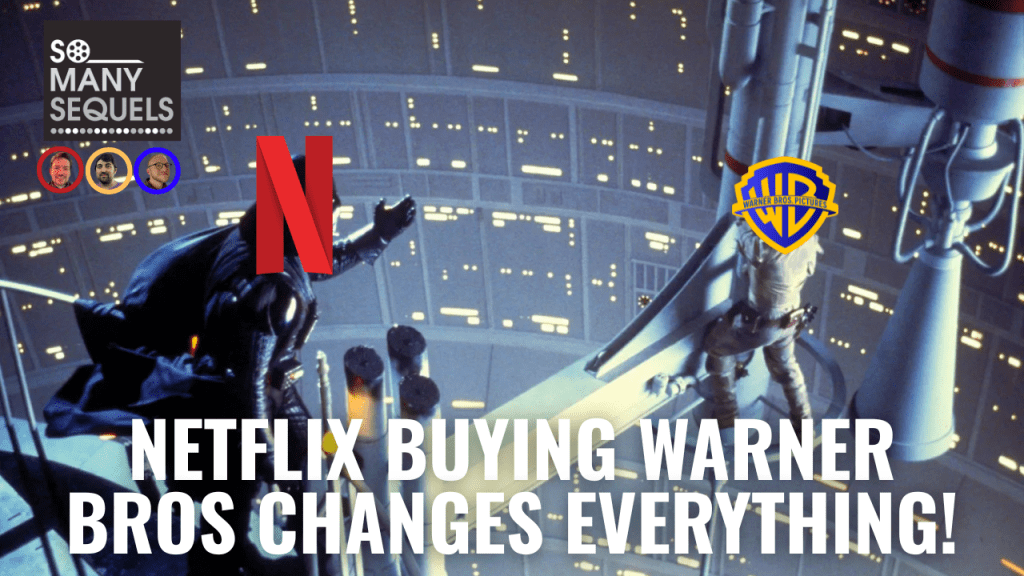
If you’ve been online at all in the past couple of weeks, you’ve probably seen the headline: Netflix and Paramount are reportedly trying to buy Warner Bros. Discovery.
On paper, it’s just another mega‑merger. Another tech‑era flex measured in billions. But the reaction to this one has been loud, fast, and unusually unified—and not in a good way.
Because this isn’t just about corporate shuffling. It’s about how movies get made, where we’re allowed to watch them, and whether “choice” in entertainment is quietly disappearing.
This isn’t about content. It’s about control.
The surface‑level argument goes like this: Netflix needs better movies, Warner Bros. has them, end of story.
But the deeper issue is that Netflix doesn’t just want movies—it wants the entire pipeline. Creation, distribution, data, audience, pricing. Start to finish. No partners. No middlemen.
Warner Bros. has historically lived in the opposite space. Theatrical releases. Physical media. Big cultural moments that exist outside an app.
Netflix’s business model doesn’t love movies the way movies need to be loved.
Netflix is extremely good at one thing: keeping you on Netflix.
Not selling tickets. Not building legacies. Not keeping films in circulation for decades. The goal is retention, not reverence.
That’s why so much of the platform functions as high‑budget background noise. It’s not designed to be savored—it’s designed to be always on. And when success is measured in minutes watched instead of impact made, certain kinds of stories stop surviving.
Theatrical releases are the first real casualty people are worried about.
Netflix has never treated theaters as a partner. At best, they’re a short‑term marketing tool. At worst, they’re a competitor to be slowly starved out.
The fear isn’t that theaters disappear overnight. It’s that releases quietly shrink. Fewer screens. Shorter runs. Fewer chances for movies to become events.
And once that muscle is gone, it doesn’t come back easily.
Physical media? Even more fragile.
This is the part fewer people want to admit out loud: streaming companies don’t want you owning movies.
Ownership breaks the subscription spell. DVDs, Blu‑rays, and restorations don’t serve an algorithm. They serve history.
If Warner Bros.’ library becomes streaming‑exclusive, whole eras of film risk becoming harder to access—not because they’re unpopular, but because they’re inconvenient to monetize.
Major guilds, theater groups, and longtime executives are openly warning that this kind of consolidation leads to fewer jobs, less diversity in storytelling, and higher prices for audiences.
When the people who make the movies are nervous, it’s usually for a reason.
We’ve seen this all before. It’s called Cable.
Streaming was supposed to fix bundling. Instead, it’s slowly recreating it.
Platforms consolidate. Prices rise. Libraries fragment. Consumers pay more for less actual choice. And eventually, piracy spikes because access collapses.
Nothing about this cycle is new.
The big question isn’t whether Netflix can buy Warner Bros.
It’s whether we’re okay with a future where the same company decides what gets made, where it’s shown, how long it exists, and how much it costs to watch.
Because once that line is crossed, it’s very hard to draw it again.
 Josh Gammon
Leave a comment