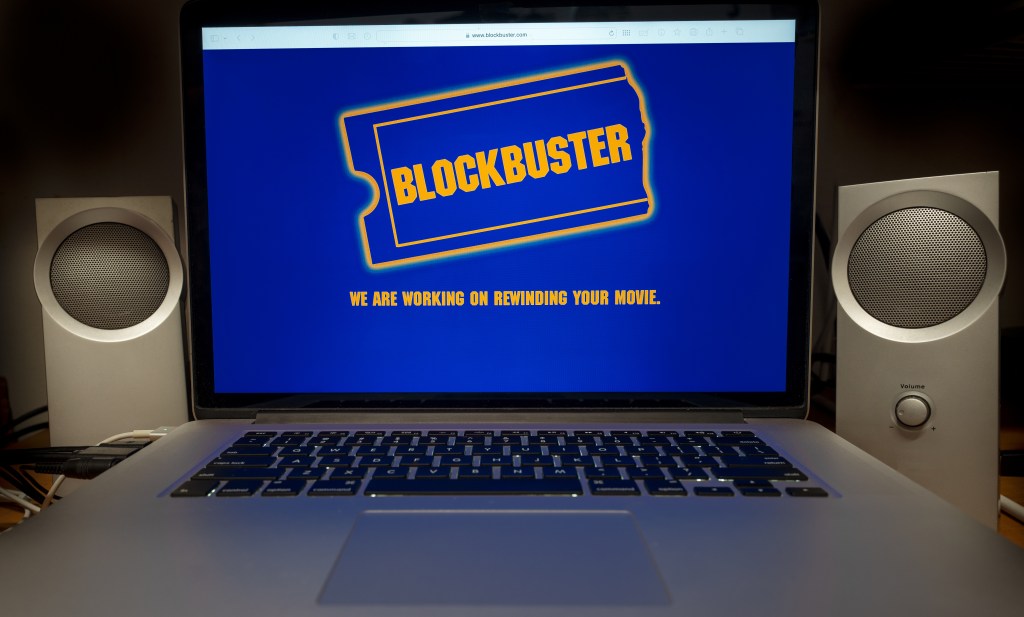
A laptop screen displays the Blockbuster logo with the text, "WE ARE WORKING ON REWINDING YOUR MOVIE."

‘Blockbuster Isn’t Going Anywhere,’ and Other Famous Last Words

I worked at Blockbuster in the company’s final year or so. Corporate had just started requiring us to upsell memberships to Blockbuster Online (RIP). The pitch was that customers could get a movie by mail and then swap it for another in-store. The catch was obvious: every customer we converted was one less renting in the store.

We were told there’d be incentives for each sign-up. I never saw a dime. It felt like even the rewards program had gone bankrupt.

All the way up to 2013 we were running on a point-of-sale system built on DOS. On more than one night I was stuck an hour past closing, on the phone with Blockbuster support, waiting for someone to reboot the system remotely because it froze again.

When I asked my manager why we would steer business away from our own register, he looked at me like I was speaking another language. Months later, when I quit, I told him I thought the company was going under. He laughed and said, “Blockbuster isn’t going anywhere.”

That building has now sat empty for more than a decade, the movie return slot still bolted to the wall. I think about it sometimes. How obvious the cracks were. How few wanted to admit it. And how important it is to trust your instincts when the math doesn’t add up.

One response to “‘Blockbuster Isn’t Going Anywhere,’ and Other Famous Last Words”

  1. After Netflix proved it wasn’t a passing fad, the death of Blockbuster felt inevitable. Still, the period between that starting and it closing lasted a longer than I expected. 

    I remember back in 2010 when I was I in college and got my PS3. I’d used my tax refund to buy it but didn’t have enough for games too. Luckily, my local Blockbuster had started offering the Game Freedom Pass, which let you continuously rent 1 game and swap it at your local store as much as you wanted, directly competing with a discs-by-mail service (á la Netflix) called GameFly. Because I’d never been a member at that Blockbuster, I was given a free week trial of the service and I rented and beat like half of their available PS3 games in that single week (the rest were either unavailable or I wasn’t interested). At the end of the free week, I went in and cancelled the subscription without paying a dime and then never entered a Blockbuster ever again.

    They offered a similar program for DVDs that you mentioned (Total Access I think was what it was called) but the bigger surprise to me was how there seemed to be NOBODY in these stores. Also at this time, a new company named Redbox had started popping up outside grocery stores, gas stations and  pharmacies where a movie could be rented for as little as 99¢/night. Movies could be rented all over town at places you already went to and could be returned anywhere. Plus, you could browse a box’s inventory BEFOREHAND and reserve a title online.

    Compare that to when I created my membership at the Blockbuster near campus, they couldn’t issue me a member card because their card maker had stopped working  and the equipment was so old they couldn’t get a replacement so they would just look you up by your phone number.

    Blockbuster squandered their brand most of all, as they could have been THE name for streaming, or THE name for kiosk-based rentals. Instead, they dug on in brick and mortar with ZERO investment in tech so they became a fossil before the Ice Age even started.

    Like

Leave a reply to codybrom Cancel reply